Chapter two
Forests through deep time
Once trees existed, the composition of forests kept changing. Coal swamps, seed plants, ginkgos, conifers, and finally flowers each took their turn as the world’s dominant canopy.
Chapter two
Once trees existed, the composition of forests kept changing. Coal swamps, seed plants, ginkgos, conifers, and finally flowers each took their turn as the world’s dominant canopy.
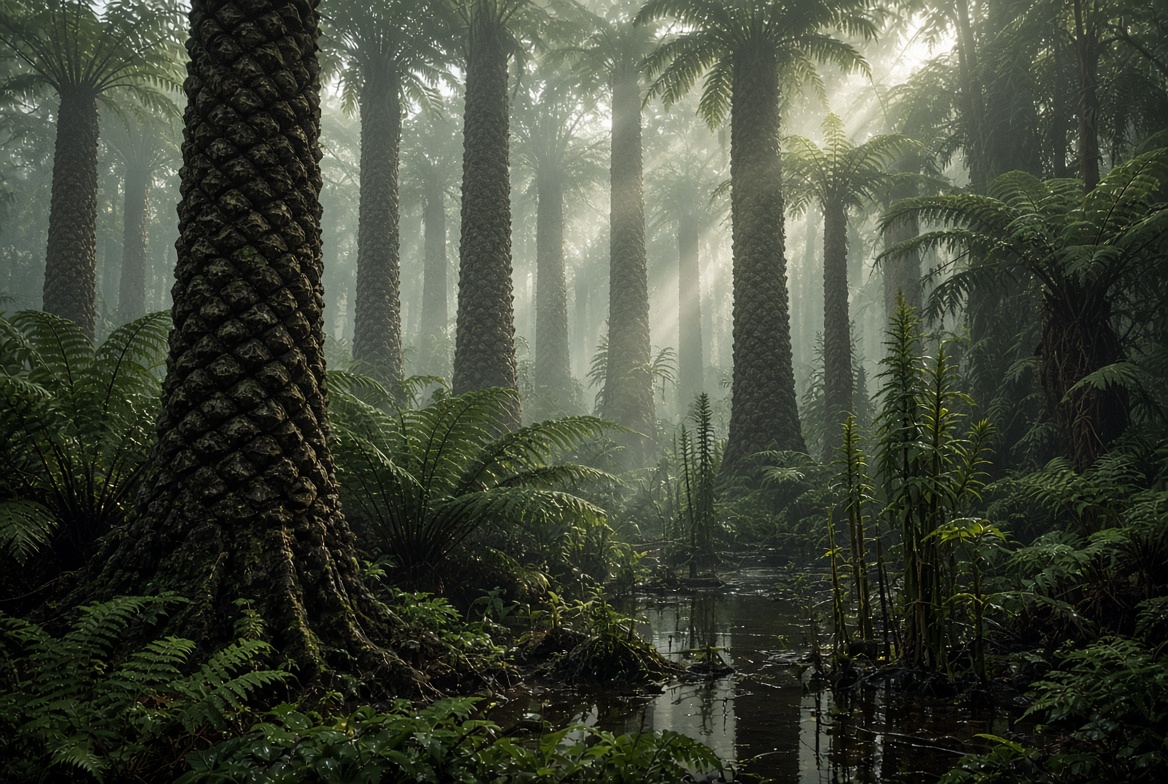
Between about 359 and 299 million years ago, equatorial continents were draped in swamp forests so productive that their buried remains still power industrial economies. The period’s name means “coal-bearing.”
The celebrities of those swamps were lycopsid trees such as Lepidodendron and Sigillaria: cousins of today’s modest clubmosses, but with trunks 30 meters high and more than a meter across, stamped with diamond leaf scars. Horsetail relatives (sphenopsids), ferns, and seed ferns filled the gaps. Later in the period, early seed plants and progymnosperms expanded onto drier ground.
These forests did not look like a modern hardwood stand. Many of the giants had relatively little true wood and lived fast. When they fell into oxygen-poor water, decay slowed. Over millions of years that peat became coal. The same burial of carbon helped drive atmospheric oxygen high and carbon dioxide low—one reason later Carboniferous and Permian climates include severe ice ages.
Toward the end of the period, a “Carboniferous rainforest collapse” fragmented the wet tropical belt. Drier conditions favored seed plants that did not need standing water for reproduction.
Seeds were a quiet revolution. A seed packages an embryo with food and a protective coat, freeing plants from a film of water at fertilization and letting them colonize uplands and seasonal climates. Gymnosperms—“naked seeds”—include conifers, cycads, ginkgos, and extinct groups such as Bennettitales.
The end-Permian extinction, about 252 million years ago, erased most species on Earth, including many forest types. Recovery was slow. In the Triassic and Jurassic, gymnosperm forests dominated: conifers on many landscapes, cycads and ginkgos in others. Petrified forests, such as the Late Triassic woods of Arizona dominated by Araucarioxylon-type logs, record that world in stone.
Ginkgoales appear by the late Permian or early Mesozoic; the sole living species, Ginkgo biloba, is often called a living fossil. Its fan-shaped leaf has changed little for well over 100 million years. Conifers diversified through the Mesozoic; pines as a group are known from the Early Cretaceous onward, around 130 million years ago.


Left: ginkgo, a gymnosperm lineage that outlasted the dinosaurs. Right: the later world of flowers, insects, and fleshy fruits.
Angiosperms—flowering plants—appear in the fossil record in the Early Cretaceous and rise steeply after about 135–100 million years ago. By the end of the Cretaceous they include trees we would recognize as belonging to families of figs, planes, and magnolias. After the asteroid impact 66 million years ago, flowering plants expanded further and now make up the great majority of tree species.
Flowers and fruits changed the contract between trees and animals. Insects, birds, and later mammals became pollinators and seed couriers. Forests grew more chemically diverse, more seasonal in some climates, and more tightly woven into animal evolution. Gymnosperms did not vanish: conifers still rule boreal and many mountain forests, and they include the tallest and some of the oldest trees on Earth.
| Interval | Approx. age | What the forests were like |
|---|---|---|
| Late Devonian | 385–359 Ma | First woody forests; Archaeopteris and cladoxylopsid trees. |
| Carboniferous | 359–299 Ma | Lycopsid swamps, ferns, seed ferns; coal formation at a planetary scale. |
| Permian–Triassic | 299–201 Ma | Seed-plant expansion, then mass extinction and gymnosperm recovery. |
| Jurassic–Cretaceous | 201–66 Ma | Conifers, cycads, ginkgos; flowering trees appear and diversify. |
| Cenozoic | 66 Ma–present | Angiosperm dominance in most biomes; ice-age cycles sculpt modern ranges. |
The last 50 million years cooled in fits. Ice sheets grew and shrank. Forests marched toward the equator in glacials and recolonized in interglacials. Grasses, which become prominent much later than trees, created new biomes—savannas and prairies—that limited woodland in dry and heavily grazed regions.
By the time modern humans appeared, most of the planet’s major tree lineages already existed. Oaks of many living groups are in place by about 23 million years ago. Boreal spruce, temperate hardwoods, tropical rain forests, and Mediterranean woodlands were already ancient ecological ideas. What was new was us.
Estimates vary, but researchers often cite on the order of six trillion trees at the dawn of agriculture—and a habitable land surface that was more than half forested at the end of the last ice age. The next chapter of tree history is no longer written only by climate and evolution. It is written by axes, fire, plows, and, more recently, by people trying to put forests back.