Chapter four
Living giants and the path ahead
Some trees germinated before the pyramids. Others are single organisms older than agriculture. Their survival is now a choice, not an accident of geology.
Chapter four
Some trees germinated before the pyramids. Others are single organisms older than agriculture. Their survival is now a choice, not an accident of geology.
Age records split into two kinds. A non-clonal tree is a single stem whose rings can be counted. A clonal tree may replace stems for millennia while the root system or genetic individual continues.
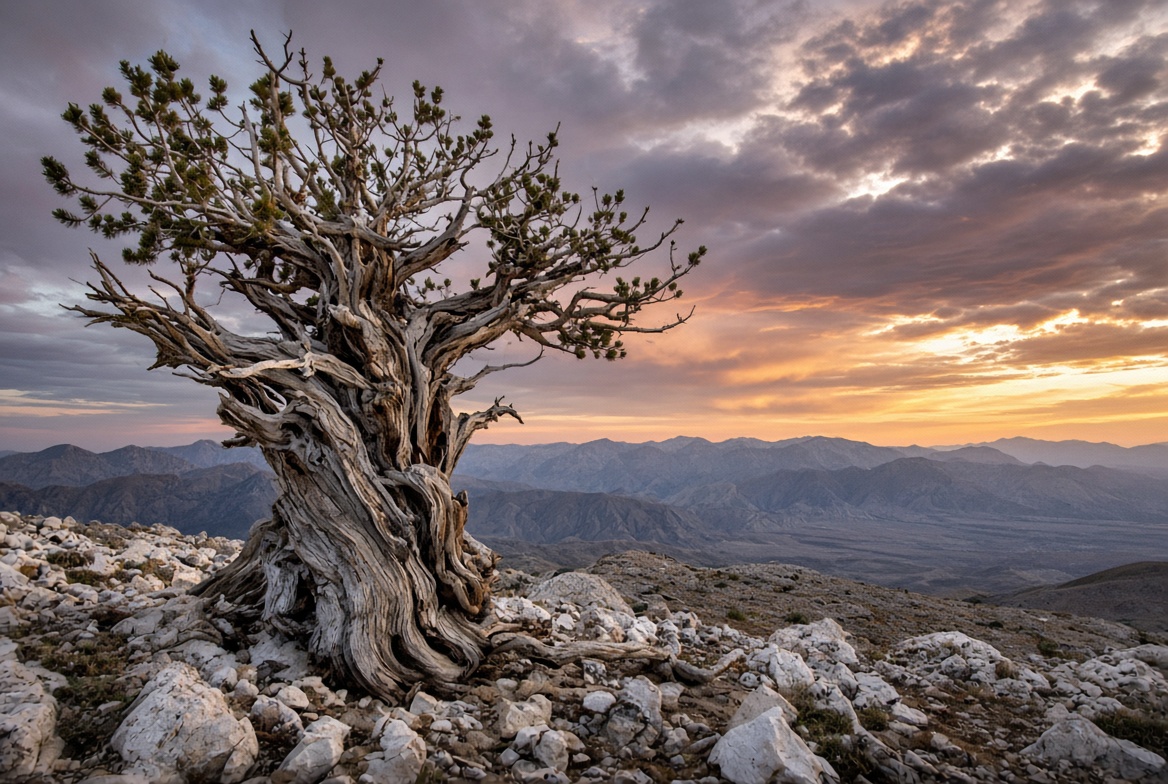
The verified oldest non-clonal tree is a Great Basin bristlecone pine (Pinus longaeva) in California’s White Mountains, known as Methuselah, more than 4,850 years old. Another bristlecone, Prometheus, was at least ~4,900 years old when it was cut in 1964 during scientific sampling. In Chile, a Patagonian cypress called Gran Abuelo (Fitzroya cupressoides) has a debated estimate that may exceed 5,000 years; conservative published ages are lower but still millennial.
Clonal records go further. Old Tjikko, a Norway spruce in Sweden, is a living stem on a root system about 9,550 years old. Pando, a quaking aspen colony in Utah, may be on the order of 14,000 years as a genetic individual. Creosote rings and other clonal shrubs push similar limits. These are not metaphors. They are organisms that have been continuously alive since the early Holocene.
| Tree | Kind | Place | Age (approx.) |
|---|---|---|---|
| Methuselah | Bristlecone pine (non-clonal) | California, USA | ~4,850+ years (ring-dated) |
| Sarv-e Abarkuh | Cypress | Yazd, Iran | ~4,000+ years (traditional / estimated) |
| Olive of Vouves | Olive | Crete, Greece | ~2,000–4,000 years (estimated) |
| General Sherman | Giant sequoia | California, USA | ~2,200–2,700 years; largest known stem by volume |
| Hyperion | Coast redwood | California, USA | Tallest known living tree, ~115.5 m |
| Old Tjikko | Norway spruce (clonal) | Sweden | ~9,550 years (root system) |
| Pando | Aspen clone | Utah, USA | ~10,000–14,000+ years (colony) |
Ages for unnamed or sensitive trees are often kept approximate to protect them from visitors.
Forest area cleared since the last ice age—about a third of the former forest on habitable land.
The dominant cause of deforestation, far ahead of cities, mines, or roads.
Still essential for fuel in many regions, and for construction, paper, and fiber worldwide.
Several countries have passed a “forest transition” and are now gaining tree cover.
Loss is uneven. Temperate Europe and eastern North America were heavily cleared centuries ago and have since rebounded in tree cover, though rarely as the original ecosystems. Tropical forests—especially in parts of South America, Africa, and Southeast Asia—are where net loss is still concentrated. Old-growth structure, once gone, does not return on a human timetable. A replanted hillside can be green in twenty years and still lack the carbon, species, and cathedral trunks of a stand that germinated when Rome fell.
A forest transition is the historical turn from net loss to net gain of forest in a country. It usually arrives after agriculture intensifies on the best land, rural people move to cities, fossil fuels replace firewood, and governments start to value watersheds, timber supply, or nature itself. Parts of Europe, the United States, Japan, and more recently China and India show versions of this curve—sometimes as native regeneration, sometimes as plantations.
Plantations are not ancient forests. Monocultures of pine, eucalyptus, or rubber can raise a tree-cover statistic while lowering biodiversity. The honest goal is layered: stop the conversion of primary forest, restore mixed native woodland where it can persist, and grow wood as a renewable material on land already in the production estate.
Climate change adds a new pressure. Drought, novel fire regimes, pests, and shifting climate envelopes are already killing trees that survived centuries of weather. Protecting Methuselah’s neighbors or a redwood cathedral now means thinking about heat and ignition as much as about saws.

Humans destroyed forests for thousands of years. We can become the first generation that lives in a world where forests, on balance, expand.
— Paraphrasing a conclusion drawn from global forest-transition research
Trees began as an evolutionary experiment in height. They became the engines of soil, coal, and climate. They became the beams of temples and the masts of empires. A few individuals now stand as witnesses that outlast kings.
The next rings will record whatever we decide. That is the odd privilege of this moment in the history of trees: for the first time, a species that can read the fossil forests and the ice-age pollen cores also holds the saw, the match, and the seedling.