Chapter one
How trees were invented
There is no single ancestor of every tree. The tree habit—wood, height, a canopy, a long life—evolved more than once after plants left the water.
Chapter one
There is no single ancestor of every tree. The tree habit—wood, height, a canopy, a long life—evolved more than once after plants left the water.
Green algae lived in the oceans for hundreds of millions of years. Molecular clocks and fossils together suggest that land plants (embryophytes) emerged somewhere in the middle Cambrian to Early Ordovician, roughly 515–470 million years ago. The first unmistakable traces are tough-walled spores from about 470 million years ago.
Those pioneers were small. They lacked true wood and deep roots. Many would have looked more like liverworts or mosses than anything that casts a shadow. The problems they solved were basic: not drying out, anchoring to rock and thin soil, and lifting water a few centimeters against gravity.
In the Silurian (about 444–419 million years ago), vascular plants appear. Cooksonia and its relatives were still only centimeters tall, but they had conducting tissues—the plumbing that would later make height possible. Branching systems improved just before and during the Devonian. Roots followed in the early Devonian. Each of those traits was a prerequisite for a tree.
~1+ billion years ago
Green algae in shallow seas. Fungi may already have been weathering rock and recycling nutrients on land.
~470 million years ago
Fossil spores mark embryophytes on land. Plants remain small and non-woody.
Silurian
Cooksonia and allies evolve plumbing. Branching becomes more complex.
Early–Middle Devonian
True roots appear. Treelike plants such as Wattieza / Eospermatopteris rise tens of feet—still without typical wood and leaves.
~385–360 million years ago
Archaeopteris grows woody trunks, deep roots, and fern-like leaves. Earth’s first extensive forests form.
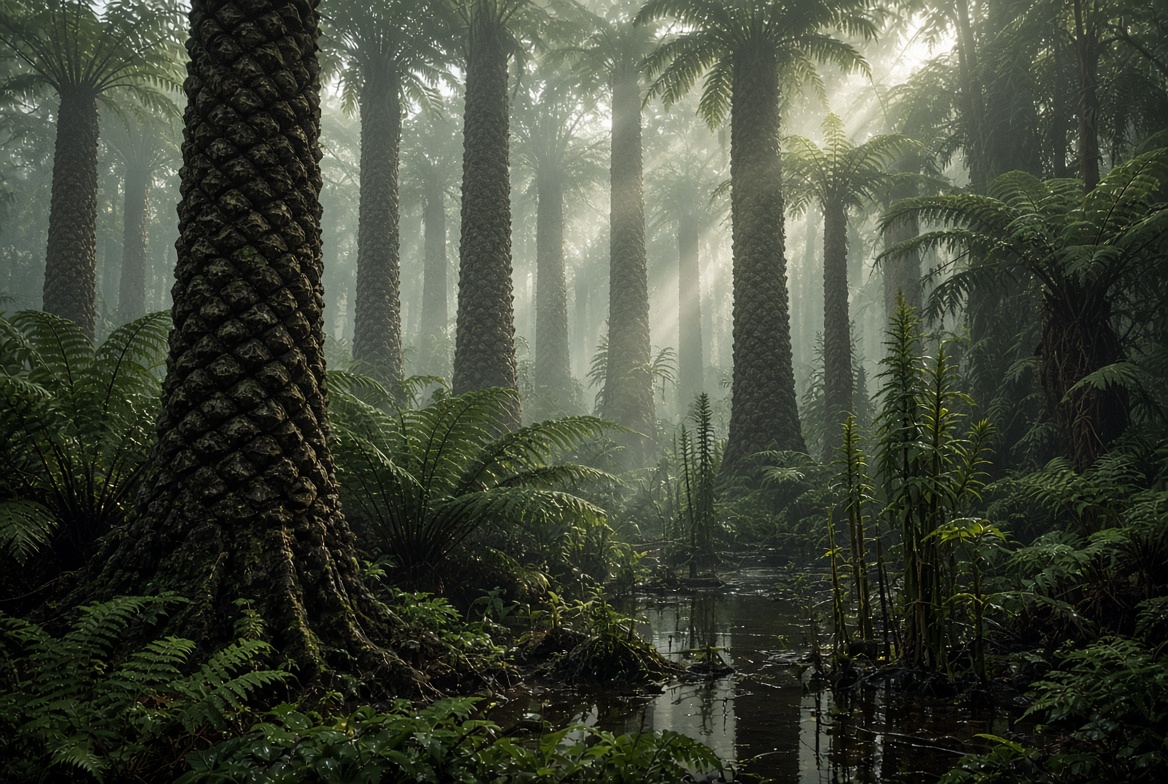
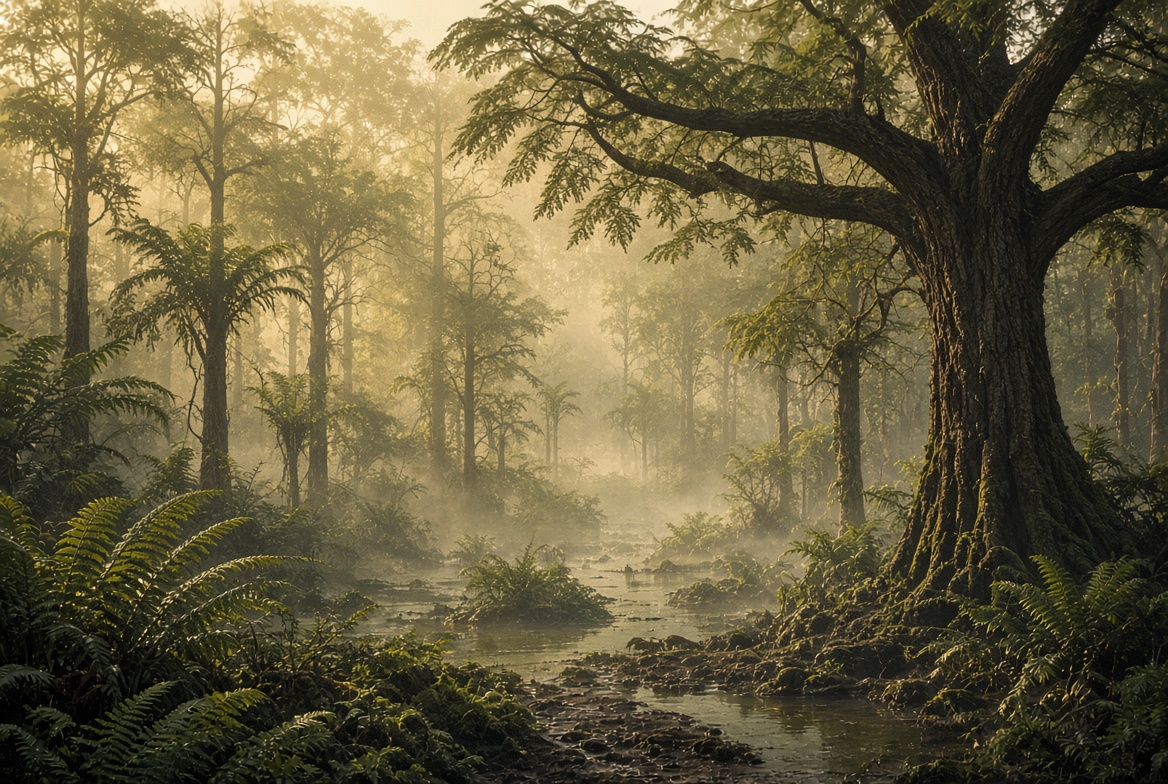
By the Middle Devonian, some plants were already tree-sized. Wattieza (also reconstructed as Eospermatopteris), known from the famous Gilboa forest in New York, stood perhaps eight to ten meters high. It looked more like a giant fern or palm than an oak: a flaring base, a column of stems, and a crown of photosynthetic twigs rather than a familiar leafy canopy.
The first plant most paleobotanists are willing to call a true tree is Archaeopteris, a late Devonian progymnosperm. It had secondary wood—the kind of growth that thickens a trunk and leaves rings—woody roots, and large fern-like leaves. Some individuals may have reached 30–40 meters. Forests mapped near Cairo, New York, show that by about 385 million years ago the ecological package of a forest was already in place: wood, roots, leaves, and a population of trees standing together.
Those anatomies did not appear overnight. Plants needed a genetic toolkit for complex branching, then for wood, then for large leaves. High carbon dioxide and heat may have delayed the spread of big megaphyll leaves; once conditions allowed them, canopies exploded.
Height is expensive. It only pays if the rewards—light, spore or seed dispersal, and a longer life—outweigh the cost of building a trunk.
A tree is a strategy, not a family. Clubmosses, horsetails, ferns, seed ferns, conifers, ginkgos, and flowering plants have all, at different times, produced tree-sized bodies.
The tree habit evolved repeatedly
That last point is easy to forget. The giant Lepidodendron of the coal swamps was more closely related to today’s tiny clubmosses than to an oak. Archaeopteris reproduced with spores, not seeds. Ginkgo is a living gymnosperm lineage that has outlasted countless “modern” trees. When we speak of the history of trees, we are speaking of a way of being a plant that the biosphere has discovered again and again.